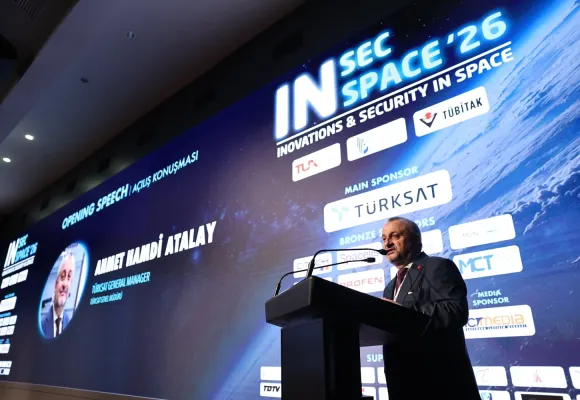
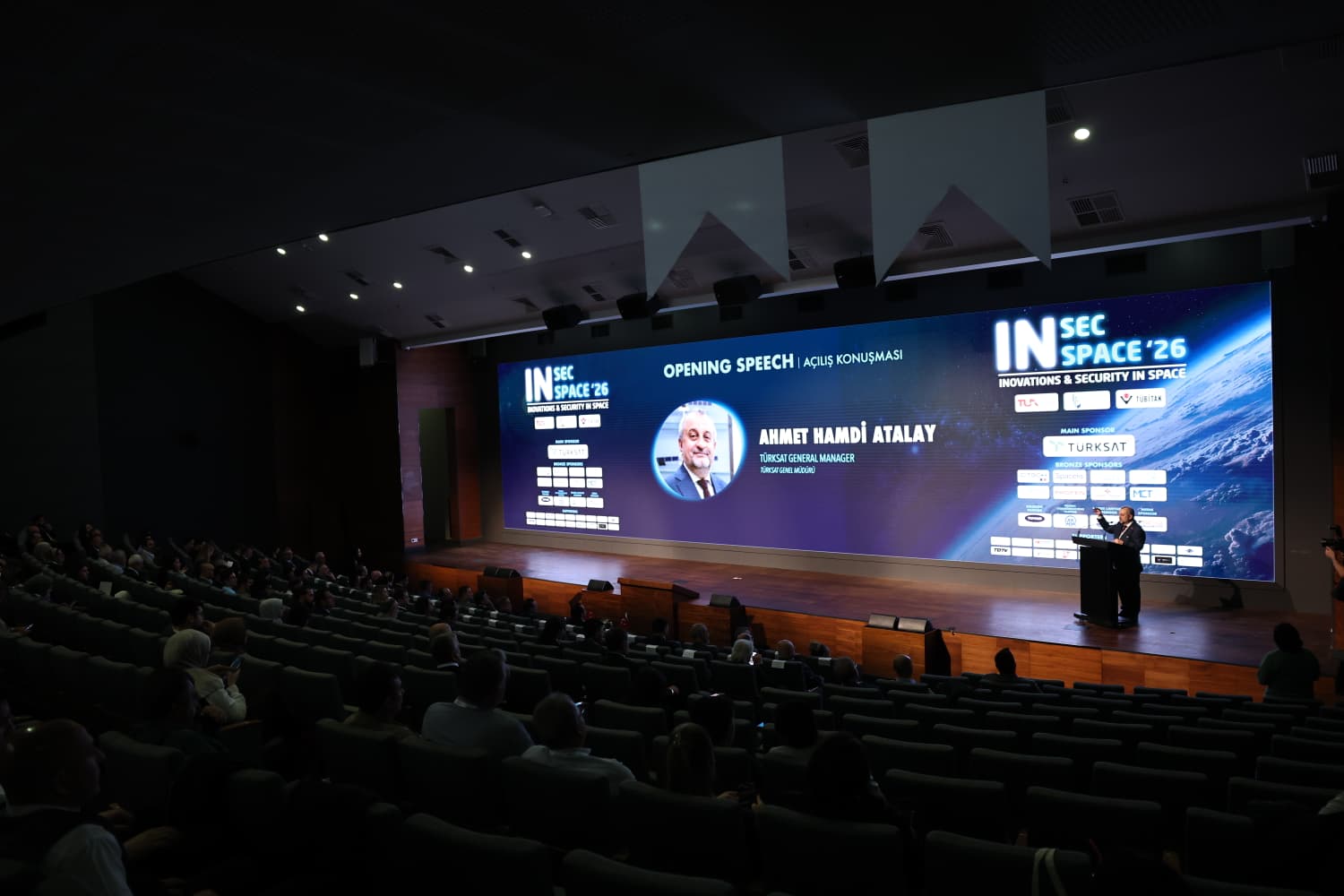
Türksat General Manager Ahmet Hamdi Atalay, noting that Turkey’s drive towards localisation in satellite technologies continues in line with the “The future lies in the skies” vision, announced that production of Türksat 7A will commence this year, following the first national communications satellite, Türksat 6A.
The INSECSPACE 2026 Conference, held under the theme “The Secure Use of Innovative Technologies in Satellite Systems”, took place at the Information and Communication Technologies Authority Conference Hall. Speaking at the conference’s opening, Türksat General Manager Ahmet Hamdi Atalay assessed the global transformation in the space and satellite sector and Turkey’s strategic position in this field. Noting that Mustafa Kemal Atatürk’s observation that “The future lies in the skies” has taken on a far more critical significance today, Atalay stated that space has now become a new sphere of sovereignty for nations. Noting that there are currently around 14,500 active satellites in space, Atalay highlighted significant changes in the sector, stating, “In addition to active satellites, there are between 3,000 and 4,000 satellites that have reached the end of their operational life. Low Earth orbit (LEO) satellites account for approximately 90 per cent of active satellites. In the sector, low Earth orbit (LEO) and constellation satellite operators are rapidly gaining ground as alternatives to traditional geostationary orbit (GEO) operators. Whilst a single operator in low Earth orbit has a target of 42,000 satellites, we see that Chinese operators are investing in this sector with a target of 100,000 satellites.
‘Production of Türksat 7A is set to begin this year’
Providing further details on Turkey’s satellite capacity, Atalay highlighted the local content ratio and engineering achievements of Türksat 6A. Recalling that Türksat currently provides services with six active communications satellites, Atalay stated, "Türksat 6A, which entered service last year, is the work of Turkish engineers from design to production. This first national satellite, produced with over 80 per cent local content, has placed Turkey among the 11 countries capable of manufacturing their own satellites. We are now taking this success, achieved through a consortium comprising ASELSAN, TUSAŞ, TÜBİTAK Space and CTECH under Türksat’s coordination, to the next level. Our planning work for the Türksat 7A satellite has reached its final stage. God willing, we will commence production this year using a similar model.” Atalay also noted that, in addition to communication satellites, observation satellites such as Göktürk-1, Göktürk-2 and İmece contribute to Turkey’s strength in space, and that two new İmece satellites are currently in the production phase.
Strategic Partnerships
Noting that Turkey’s geopolitical position has entrusted Türksat with the role of a bridge on the international stage, Atalay stated that the cooperation agreements signed with Chinese satellite companies complete this chain. Emphasising the strategic importance of communications satellites for nations, Atalay stated, “Communications satellites are not merely commercial assets; they are strategic assets. Entrusting data to unreliable infrastructure poses significant risks in terms of communications security. You must carefully assess whom you entrust your data to. Türksat is Turkey’s national flag-bearer and, with its domestic infrastructure, guarantees secure service. I would like to remind you that security and accessibility risks must be taken into account when data is entrusted to other entities.”